
Running v0.2.50-beta · this page last changed 2026-11-01 · All docs
Grounding and fact checking
Steven's rule (2026-10-18): cut unverifiable sentences and send; block only on privacy or a contradicted Must read.
Two ideas run through everything below:
- Grounding. Every claim a reader sees must trace back to text the pipeline actually holds: the archived item, the article the reader fetched, or a page found by search. A model's own knowledge doesn't count as a source.
- Fetched text is data. No step calls a model with fetched text as instructions. Pages, posts, newsletters and replies are material to assess, never commands.
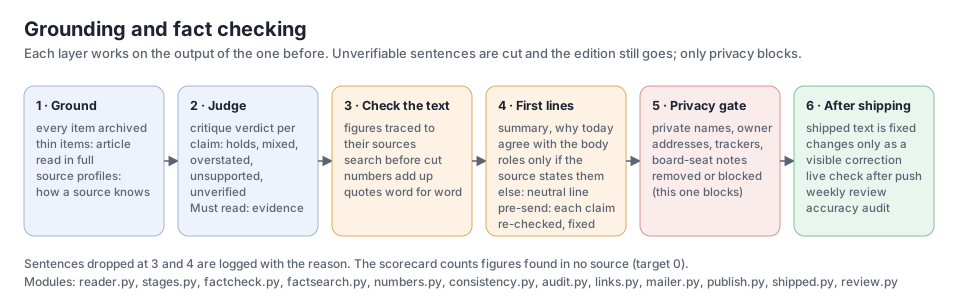
Every step runs in the morning run, before the email and the audio.
1. Ground: what the edition may draw on
| Step | Where | What it does |
|---|---|---|
| Archive | pipeline/archive.py |
Every fetched item is stored append-only with its text, so later checks search what the source actually said. |
| Reader | pipeline/reader.py, stage verify |
An item under 600 characters (headline, teaser, social post with a link) gets its linked article fetched through the network guard. If it's unreadable, the verdict is "Unverified". A post with no link is judged as a post. |
| Source weighting | pipeline/profiles.py, source_profiles.yaml, docs/SOURCE-PROFILES.md |
Sources are weighed by how they know things. A Must read needs a primary source, a report or a first-hand test. Company posts count as self-reported. |
| Citations | pipeline/links.py |
Links point at the real article, not an aggregator or tracker. |
2. Judge: how strong is each claim
| Step | Where | What it does |
|---|---|---|
| Critique | pipeline/stages.py, stage critique |
Each claim gets a verdict: holds, mixed, overstated, unsupported or unverified. |
| Evidence check | run.py, stage verify |
Every Must read without a verdict gets one, using the article text from the reader. |
| Label refinement | editorial.refine_unverified (v0.2.48) |
"Unverified" says which kind: Reported (a news outlet reports it; the parties haven't confirmed), Self-reported (only the claimant), Single source (one post or commentary). Plain "Unverified" stays for the rest. Machine phrasing in evidence lines is put into plain words (editorial._LINT). |
3. Check the text: every figure and quote
| Step | Where | What it does |
|---|---|---|
| Figure trace | pipeline/factcheck.py, write stage |
Every figure in the edition is looked up in the text of its sources (raw items, plus articles the reader read). Dates, years and chapter numbers are ignored. Differences and ratios of source figures count as traced. |
| Search before cut | pipeline/factsearch.py |
An untraced figure is looked for in the story's own linked articles, then on the web (Bing's public RSS search: free, no account, top 3 results). A page counts only if the figure sits within ~600 characters of the name nearest to it in the sentence. If it's found on the web, the sentence stays, with a link to the outlet. At most 8 figures per edition. Requests are logged to logs/news-search.jsonl. Switch it off with factcheck.search: false. |
| Cut or flag | factcheck.check |
If a figure is still untraced, the sentence is cut in factual sections (day in brief, Top of mind, What happened, Worth knowing, In brief, Recommended reading). In headlines and analysis (Evidence check, Our read, views, Open questions) it's flagged in the run log only. |
| Number check | pipeline/numbers.py |
A stated difference that doesn't add up is corrected. Changes and near-twin figures are flagged. |
| Quotes | stages.verify_quotes |
Words in quotation marks must appear word for word in the source material. If they don't, the quotation marks come off and the words stay as a paraphrase. |
| Speech | pipeline/speech.py |
Prices, rates, ranges and model sizes are spoken correctly ("two dollars for input and ten for output"). |
4. The lines readers see first (deep dives since v0.1.9, the daily briefing since v0.1.14)
Summaries and "Why today" lines, and the daily briefing's day in brief and Top of mind, appear in the email, on the
site and in the podcast notes before anyone reads the body. So they get their own check (pipeline/consistency.py),
which runs against the already-checked body. A figure belongs to its whole story there, so a line can name the
company in its lead and give the figure in the next sentence. A sentence is dropped if:
- a figure in it isn't in the body;
- it names none of the companies or people the body ties that figure to;
- it says something was "not disclosed" when the body or a source gives it for the same company (a question asking for the figure, or a sentence saying it's lacking, doesn't count).
A figure the body doesn't carry can still stand if a source sentence ties it to the same names. A Top of mind bullet whose lead fails, or whose every other sentence fails, is dropped whole.
Across days (flag, not cut). A "not disclosed" claim is also compared with the previous 14 editions. If an earlier day gave that figure for the same company, the run log flags it for review. A day can be right about its own sources and still contradict the record, so this one is for a person to judge.
./np consistency [DAY|all] runs all of this over published editions as a dry run. On 2026-10-23 it ran over all
18 editions and 8 deep dives and found one misattributed figure (fixed by a correction) and two cross-day flags.
The "Why today" line is written from the checked body, never copied from the previous day's topic suggestion. Agenda lines can claim a role ("founder", "CEO", "investor in") only when the item's own source says so. Otherwise they read: "The author's role and any stake aren't stated in the source."
Why this layer exists: on 2026-10-23 a deep dive's body was right, but its summary attached a figure to the wrong company and said a disclosed number wasn't disclosed. The day before, an unsourced Agenda line had given an investor the wrong role. Each fact was in the sources. The mistake was in short lines that were written separately and never checked against the body.
4b. The briefing against the day's deep dive (since v0.2.5)
After the deep dive is written and before the briefing audio is made (consistency.align_deepdive):
- a Must read the deep dive covers shrinks to one sentence and a pointer ("Today's deep dive covers this story in full"), so no story is told twice in one episode;
- a "not disclosed" line in the day in brief or Top of mind that the deep dive answers is dropped;
- an opening line about the deep dive's story that calls something unverified or unclear is flagged for review in the run log (meaning, not just names, decides that one, so it is not cut automatically).
4c. Labels that match their evidence (since v0.2.5)
An evidence check that itself says the claim is self-reported, unverified or untested can't carry the label
"Holds"; it reads "Unverified". A story whose source link is a bare homepage, or a sponsored or webinar page,
can't be a Must read (editorial.weak_lead).
4d. The pre-send fact check (since v0.2.33)
Steven, 2026-10-30, after a wrong agency name ("CDIC" for the Government of Canada) went out and was corrected
later: check before sending, not after. Once the draft is written, and before the audio, the takes email and the
send, pipeline/audit.presend checks every factual sentence of the top section, the What happened lines and Worth
knowing (up to 24) against that story's own source texts, with the same verdicts as the after-ship audit.
Sentences naming an acronym no source contains go first, and the model is told which names are missing.
- A wider look. Excerpts are ranked, best match first (4,800 characters per claim). A claim the sources "don't address" is looked at again with up to 12,000 characters of them before anything else happens.
- A source we didn't cite. A claim still partly right, contradicted or not found gets a search
(
factsearch.pages_for: Bing News then web RSS, free, no account; at most 6 per edition). Only live pages fetched now count, and only if they name the claim's main name and also a second name or a figure from it; a homepage or section front never counts (v0.2.34). Government and regulator pages come first. The claim is checked again with them. - The rewrite. A partly-right or contradicted line is rewritten (prompt
audit_fix.md) to what the cited sources and found pages say, preferring a primary source when they differ. It keeps its label and every link; it may add one link, and only to a page found in step 2; that page also joins the story's Sources line. A rewrite narrows the original claim and never swaps in a different one; it may come back empty, and then Steven decides. Anything else is refused. - A second judge. The rewritten line is checked by a different model (
llm.stages.judge2, the local model by default), so the model that rewrote it doesn't grade it, one claim per call, falling back to the first model if it doesn't answer. A rewrite is kept only when this check confirms it; otherwise it is undone and goes to Steven ("rewrite not confirmed"). The after-send audit uses that model too. - Steven. What still doesn't hold (a refused rewrite, a re-check that fails, a name no source has) is listed at the top of the takes email ("Check: …"), while the edition is held. Names aren't cut automatically; figures still are (section 3).
Saved in data/audit/DAY-presend.json. The day page ends with a Notes footnote: when the check ran, how many
lines it rewrote and how many with a newly cited source, and every later correction with its date and time (ET).
A corrected page also has a one-line pointer at the top. analysis.presend_check: false turns it off.
4e. The deep dive, before it is recorded (since v0.2.33)
Facts only (v0.2.44): a sentence that frames a reading ("the AI-realist reading says…"), imagines an example
("Picture a startup…") or gives our view is not checked (audit.dd_framing); in How people read it, only a sentence
that attributes a view to someone is. On 10-31, most of the 12 held items were of that kind.
The same check runs on the deep dive's script (audit.check_sections, from deepdive.run after the script checks
of section 3), turn by turn, so a two-voice script whose turns share a section keeps every turn (v0.2.36): up to 24 sentences of Why today, Plainly, the evidence and How people read it (So what and What to
watch are analysis), names no source has first, against the dive's sources (archived stories plus the live pages
it cites). Not found → a wider look → a search; partly right or contradicted → the sentence rewritten as one plain
spoken sentence (prompt audit_fix_spoken.md: no links or markup, passes the audio rules, may say "according to
…" for a found page); the second model re-checks it; a found page whose fix checks out joins the dive's Sources.
The script checks run again over the result. Saved in data/audit/DAY-deepdive.json.
What's left for Steven appears in tomorrow's draft Doc ("Fact check: please look", above Steven's take; he
answers in Notes for the editor, and the morning revision is checked again) and in the takes email. The deep-dive
page ends with the same Notes footnote. deepdive.fact_check: false turns it off.
5. Privacy gate: the one check that blocks
links.py, mailer.privacy_gate, publish.scan_site, stages.scrub_private: private names, the owner's
addresses, board-seat notes and tracker links never leave. A hit removes the text. If anything is still left at
the gate, the send is blocked.
6. After shipping
- Shipped text is fixed (
pipeline/shipped.py). Once a day's email has gone out, its page, deep dive and audio can change only through a visible correction: after a hand edit, run./np correct DAY "what changed". The note shows on the day page and the deep-dive page. A publish that would change a shipped edition without a correction is refused. - Live check. After each publish, the newest pages, both feeds and the latest MP3 must answer. If they don't, the previous site is restored and the email waits.
- Measuring. The scorecard (
./np quality) reports "Figures in no source" (target 0). The weekly review (pipeline/review.py) reads a week of editions side by side and catches what a single day can't, such as two days disagreeing about the same fact.
Commands
./np factcheck              dry run on the latest edition: FOUND / CUT / FLAG, nothing edited
./np factcheck 2026-10-13   same for a day
./np factcheck probe "Harvey raised $300M at a $5B valuation." '$5B'    one live search
./np consistency all        first lines vs the body, Agenda roles, cross-day flags over published editions (dry run)
./np audit deepdive DAY     the deep-dive check (4e) on a recorded dive, as a dry run
./np correct DAY "note"     record a hand edit to a shipped edition (shown on its pages)
./np review weekly          the weekly quality review
Deep dives have their own checks (docs/DEEP-DIVES.md): links opened, quotes verified, unsourced $ and % sentences cut, and the summary and "Why today" lines checked as in section 4.
Known gaps (next)
- Only "not disclosed" claims are compared across days. Other contradictions between days (different figures for the same thing) are left to the weekly review.
- The figure and consistency checks match names, not meaning; the pre-send check (4d) reads meaning, but only up to 24 sentences, and Evidence check / Our read / Open questions are analysis and aren't rewritten.
- A claim is only as good as its source: a report that misreads a release passes against that report. The search in 4d prefers the primary source, which catches this when the release is findable; otherwise it is caught only by the after-send check or a reader.
Cut sentences (since v0.2.48)
On 2026-11-01 the board-seat scrubber removed "a disclosure." from the middle of a deep-dive sentence ("a joke on a
recording, not a disclosure. But...") and left "not But". The scrubber now removes that lead-in only at the start of a
sentence, and the deep dive's script check lists any sentence that looks cut short (deepdive.broken_sentence) in its
notes, so it is fixed before recording.